
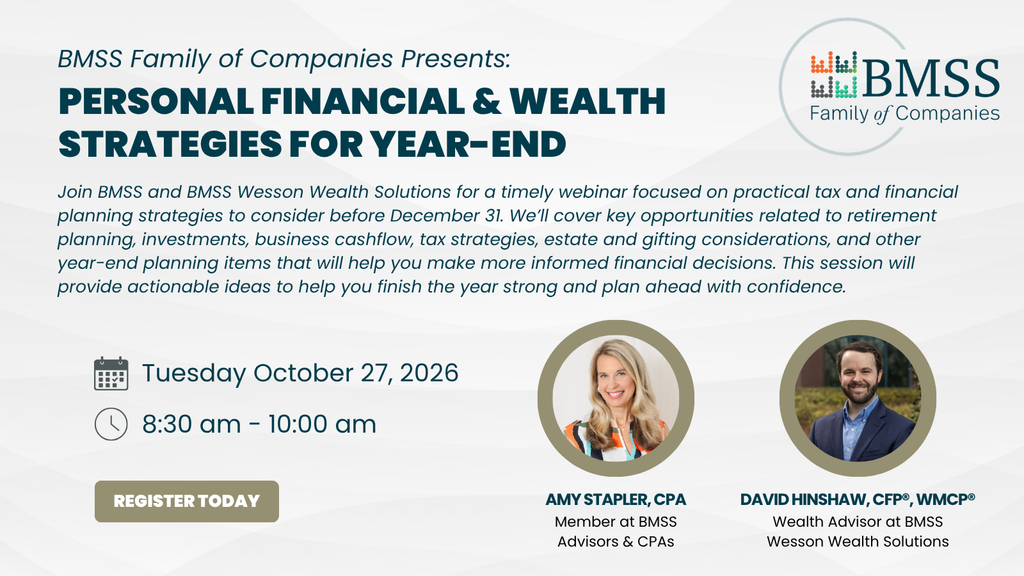
Luke Brooks and David Hinshaw (BMSS Wesson Wealth Solutions), alongside Amy Stapler, CPA (BMSS), discuss actionable year-end planning strategies and why tax and wealth advisors should coordinate decisions around both immediate tax impact and long-term goals.
Begin with an Accurate 2026 Tax Projection
- Review wages, bonuses, business and K-1 income, equity compensation, investment gains and distributions, retirement income, and major life changes.
- Understand marginal versus effective tax rates, estimated payments, withholding, and the impact of potential year-end transactions.
- Takeaway: A current projection provides the foundation for informed decisions before December 31.
Make Tax Decisions in the Context of Your Income Year
- Lower-income years may offer opportunities for Roth conversions, gain harvesting, or accelerating income.
- Higher-income years may call for retirement contributions, appropriate deductions, and strategic timing of income or expenses.
- Takeaway: The best strategy depends on today’s tax bracket and how it compares with expected future years.
Coordinate Retirement and Investment Planning
- Evaluate Roth conversions alongside future required minimum distributions, Medicare premium impacts, and legacy goals.
- Review retirement plan deferrals, capital gain and loss harvesting, concentrated stock positions, and tax-efficient asset placement.
- Takeaway: A current-year tax saving is not automatically the best long-term financial choice
Review Charitable Giving Before Year-End
- Consider qualified charitable distributions (QCDs), gifts of long-term appreciated assets, and donor-advised fund strategies where appropriate.
- Allow time for custodians to process stock gifts and QCDs; year-end transfer deadlines matter.
- Takeaway: Coordinate giving with the tax projection and charitable goals rather than waiting until filing season
Include Family, Estate, and Education Goals
- Review estate documents, beneficiaries, annual exclusion gifts, and education funding through 529 plans.
- Understand the different purposes of 529 accounts, UTMA accounts, Trump accounts, and flexible taxable brokerage accounts.
- Takeaway: Choose accounts and gifting strategies based on how and when the family expects to use the assets.
Understand New Tax Deductions and Opportunities
- Auto Loan Interest Deduction: Eligible taxpayers may deduct up to $10,000 in qualifying auto loan interest, subject to income limits.
- Senior Deduction: Individuals age 65 and older may qualify for an additional $6,000 deduction, subject to income limitations.
- Mortgage Interest Limitations: Review deduction limits before purchasing a second home or taking on additional mortgage debt.
- Takeaway: Understanding new tax provisions and eligibility requirements can help individuals identify valuable savings opportunities before year-end.
Important Dates & Next Steps
- Late November: initiate time-sensitive appreciated-security gifts and QCD requests.
- December 7: Medicare annual open enrollment ends.
- December 31: Key deadline for Roth conversions, RMDs, QCDs, gifts counting towards annual gift exclusion, 529 contributions, and payroll deferrals.
- January 15, 2027: Generally the fourth-quarter 2026 federal estimated tax deadline, subject to applicable exceptions.
The Bottom Line
Identify one concrete action now: request a tax projection, review investment activity, start a charitable transfer, update an estate document, or schedule a conversation with your advisors. Working together, BMSS and BMSS Wesson can help align near-term decisions with a lasting financial plan.
Learn more: www.bmss.com | www.bmsswesson.com
Watch the webinar recording here.
Download the slides here.
Download the whitepaper here.
Disclamer
For Educational and Informational Purposes Only
This presentation is provided for general educational and informational purposes only and should not be construed as individualized investment, financial, tax, or legal advice. The information presented is general in nature and may not be appropriate for every individual’s financial circumstances.
Investment Advisory and Tax Professional Roles
Investment advisory services are offered through BMSS Wesson Wealth Solutions, a registered investment adviser. Registration does not imply a certain level of skill or training. The Investment Adviser Representative (IAR) participating in this webinar provides information from an investment and financial planning perspective. The Certified Public Accountant (CPA) provides information from a tax planning perspective. Unless otherwise expressly disclosed, the CPA is acting in an independent professional capacity and is not providing investment advisory services on behalf of BMSS Wesson Wealth Solutions.
Tax Planning Considerations
Tax laws, regulations, and interpretations are subject to change. Any tax planning strategies discussed may not be suitable for all individuals and depend on each person’s specific circumstances. Attendees should consult with their own qualified tax and legal professionals before implementing any strategy discussed. No representation is made that any strategy will result in a particular tax outcome or savings.
Investment Risks and Limitations
All investing involves risk, including the potential loss of principal. No investment or financial planning strategy can guarantee a particular result. Any examples or illustrations are hypothetical or provided for educational purposes unless otherwise indicated.
Additional Information
Information presented is believed to be reliable as of the date of the webinar but is not guaranteed to be accurate or complete. BMSS Wesson Wealth Solutions does not undertake to update this presentation for subsequent changes in tax laws, market conditions, or other developments.